
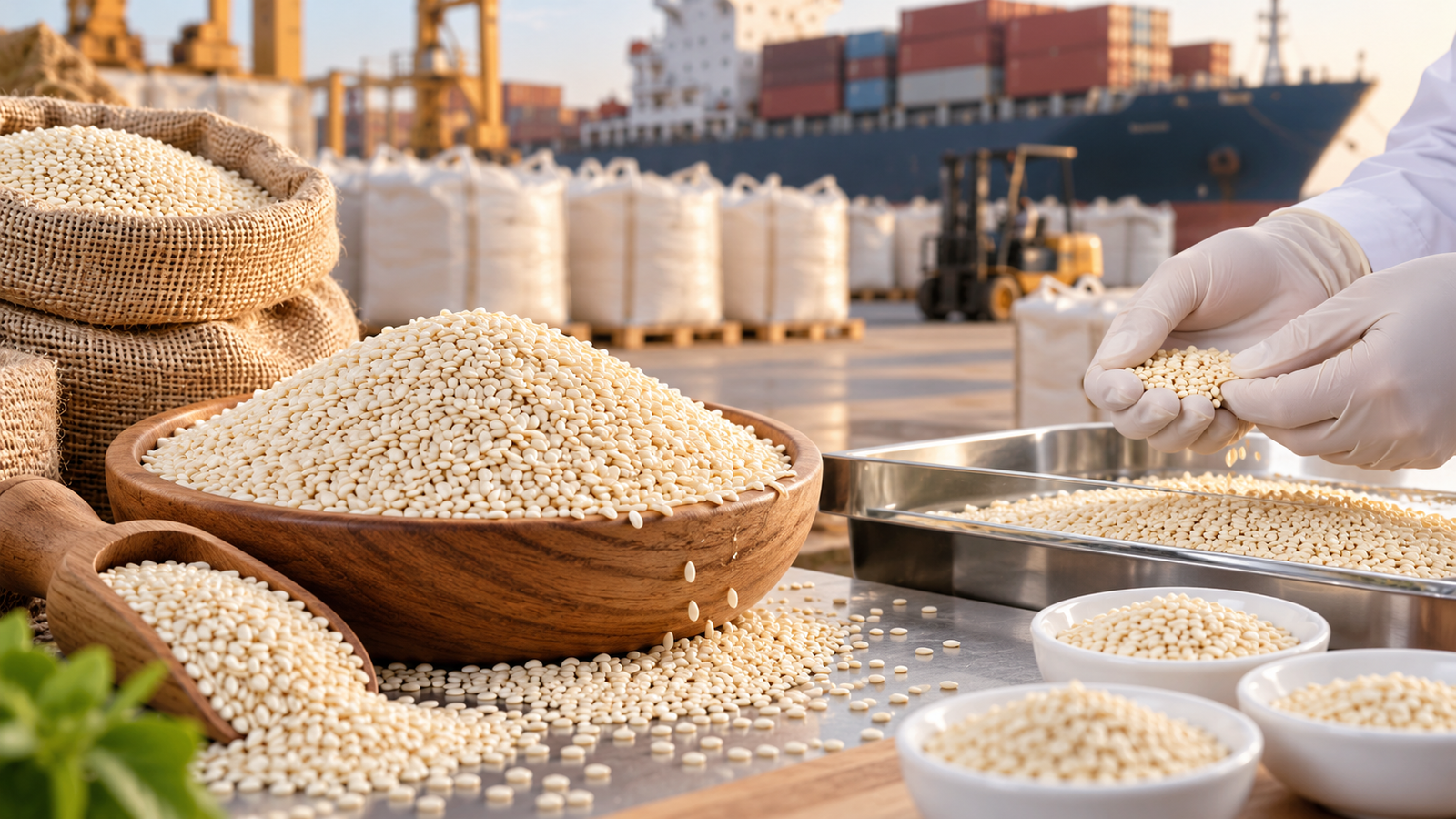
Two shipments of hulled sesame seeds can look almost identical, but their quality may differ. One may contain more moisture, while another may have broken kernels or pieces of the outer hull that affect the final food product. These differences become important when a manufacturer is buying several tons for regular production.
Before confirming an order, buyers need to agree on hulled sesame seeds specifications covering purity, moisture, color, hulling quality, food safety, and packaging. A clear specification helps the buyer compare suppliers, review samples, and check whether the delivered product meets the requirements of their business.
This guide explains what importers and food manufacturers should check when purchasing hulled sesame seeds in bulk. It also includes trade statistics, practical buying examples, and the documents needed to make a more informed sourcing decision.
- What Are Hulled Sesame Seeds?
- Pakistan's Position in the Global Sesame Seed Market
- Key Hulled Sesame Seeds Specifications for Bulk Buyers
- Food Safety Requirements for Hulled Sesame Seeds
- How Hulled Sesame Seeds Are Prepared for Export
- Choosing Hulled Sesame Seeds for Different Food Applications
- Documents Buyers Should Request Before Placing an Order
- How to Compare Hulled Sesame Seed Suppliers
- Common Mistakes When Buying Hulled Sesame Seeds
- Hulled Sesame Seeds Bulk Buying Checklist
- Source Hulled Sesame Seeds From FieldFusion Corp
- FAQs
- What are the main specifications for hulled sesame seeds?
- What purity level should hulled sesame seeds have?
- What moisture content is acceptable for hulled sesame seeds?
- Are hulled sesame seeds suitable for tahini manufacturing?
- What is the difference between natural and hulled sesame seeds?
- Which documents should bulk buyers request?
- How can buyers check sesame quality before placing a large order?
- Can buyers request quality reports from FieldFusion Corp?
- Where can international buyers source hulled sesame seeds from Pakistan?
What Are Hulled Sesame Seeds?
Hulled sesame seeds have their outer covering, called the hull, removed during processing. This gives white sesame seeds a lighter appearance and makes them suitable for food products where a smooth texture and consistent color are important.
They are commonly used in tahini, bakery products, confectionery, and other processed foods. Natural sesame seeds still have their outer covering, so the two types can behave differently during food production.
For example, a bakery may choose hulled sesame seeds for the uniform appearance they provide on burger buns. A tahini manufacturer may prefer them because removing the hull can help produce a smoother, lighter-colored paste.
FieldFusion Corp offers several sesame varieties, including natural machine-cleaned, natural color-sorted, hulled, and hulled roasted sesame seeds. Buyers can review these options through the FieldFusion product portfolio before discussing their requirements with the export team.
Pakistan’s Position in the Global Sesame Seed Market
Pakistan has an established presence in international sesame trade, supplying markets across Asia, Europe, and other regions. Its export figures help show the country’s importance as a sourcing origin, although buyers still need to assess individual suppliers.
According to World Bank WITS trade data, Pakistan exported approximately 280,061 metric tons of sesame seeds worth US$345.73 million in 2024. China received around 192,279 metric tons, making it Pakistan’s largest sesame export destination that year.
| Pakistan’s sesame exports | 2024 figures |
| Total export volume | 280,061 metric tons |
| Total export value | US$345.73 million |
| Export volume to China | 192,279 metric tons |
These figures cover sesame seeds under HS code 120740, including different grades and types, rather than hulled sesame seeds alone. They show the scale of Pakistan’s sesame exports but do not establish the quality or testing results of any individual shipment.
For international buyers, the next step is to identify a supplier that can offer the required grade and provide appropriate product information. Purity, processing methods, test results, and shipment terms should be reviewed before placing a commercial order.
Key Hulled Sesame Seeds Specifications for Bulk Buyers
A product specification sheet explains what the buyer expects to receive and how those expectations will be measured. Without this agreement, two suppliers may quote different grades under the same general product name.
The CBI guide to the European sesame market identifies purity, color, oil content, and seed condition as important quality factors. It also explains that different buyers require different grades, so specifications must be agreed for each purchase.
| Specification | What buyers should check | Why it matters |
| Purity | Percentage of material meeting the agreed definition | Helps assess product cleanliness |
| Moisture | Maximum acceptable moisture content | Supports proper storage and handling |
| Foreign matter | Dust, stones, other seeds, and unwanted material | Helps reduce processing problems |
| Color | Required white or creamy-white appearance | Affects the finished product |
| Hulling quality | Acceptable amount of remaining hull | Can affect texture and appearance |
| Damaged seeds | Broken or discolored kernels | Supports product consistency |
| Food safety | Required microbiological and chemical tests | Supports safety requirements |
| Packaging | Bag material, weight, sealing, and labeling | Helps protect the shipment |
These checks provide a useful starting point, but the table is not a universal specification for every hulled sesame order. Buyers should agree on the relevant limits, sampling methods, and test procedures according to their intended use.
Purity and Foreign Matter
Purity is one of the first details importers review when buying sesame seeds. It measures how much of a sample meets the agreed product definition, while foreign matter may include dust, stones, plant material, or seeds from other crops.
CBI provides indicative sesame trade grades ranging from above 97% purity to above 99.99% purity. These figures show the range of grades in the industry, but they should not be treated as fixed requirements for every hulled sesame shipment.
Example: How a small purity difference affects a bulk order
Consider two suppliers offering a hypothetical shipment of 20,000 kg of sesame seeds. Supplier A offers 99.0% purity, while Supplier B offers 99.5%, with the same definition and measurement method used in both quotations.
| Detail | Supplier A | Supplier B |
| Shipment quantity | 20,000 kg | 20,000 kg |
| Agreed purity | 99.0% | 99.5% |
| Material outside purity requirement | 200 kg | 100 kg |
Under these assumptions, the difference is 100 kg of material across the shipment. This does not mean that all material outside the purity requirement is foreign matter or that the remaining seeds automatically meet food safety standards.
The example shows why buyers should compare grades carefully instead of focusing only on the price per ton. Both the purity percentage and its definition should be recorded in the purchase agreement.
The figures above are illustrative and do not represent actual supplier quotations or FieldFusion test results.
Moisture Content
Moisture affects how well sesame seeds maintain their condition during storage and transport. Excess moisture, especially when combined with poor storage conditions, can increase the risk of mold growth and product damage.
CBI’s indicative grading examples include moisture levels below 7.5% for a basic sesame grade and below 5% for a high grade. The same guide recommends keeping stored sesame below 6% moisture under suitable storage conditions, although buyers must still agree on the requirement for their particular order.
Example: When a shipment exceeds the agreed moisture limit
A tahini manufacturer agrees with a supplier that the maximum moisture content must be 5.0%. Before shipment, the supplier provides a test report showing 5.2% moisture for the relevant lot.
The difference is only 0.2 percentage points, but the reported result is still above the agreed limit. The buyer should review the test result and follow the acceptance procedure in the contract before approving the shipment.
This example highlights the importance of setting moisture limits in writing and checking them through an agreed method. It also shows why a general product description cannot replace the test results for a specific lot.
This is a hypothetical purchasing example, not a reported FieldFusion shipment.
Color and Hulling Quality
Hulled sesame seeds usually have a white or creamy-white appearance, but natural variations may occur. A consistent color is particularly important for bakeries and other manufacturers whose finished products show the seeds on the surface.
Hulling quality refers to how effectively the outer covering has been removed. Seeds with more remaining hull may produce a different texture or appearance when used in products such as tahini.
For this reason, buyers should review representative samples and agree on acceptable color variation and remaining hull levels. A production trial may also help determine whether the offered grade works well with the manufacturer’s equipment and recipe.
Damaged and Broken Seeds
Some sesame kernels may become broken or damaged during processing, handling, or transport. The acceptable amount depends on the intended application and the buyer’s quality requirements.
A bakery using whole seeds on bread may place greater importance on their appearance than a business grinding sesame into paste. Both buyers should still agree on suitable defect limits so that later shipments can be checked against the same requirements.
Food Safety Requirements for Hulled Sesame Seeds
Clean-looking sesame seeds do not necessarily meet food safety requirements. A product can have an acceptable color and purity level while still needing checks for microorganisms, pesticide residues, or other contaminants.
Food safety requirements depend on the destination market, the intended food product, and the manufacturing process. Buyers should identify these requirements before ordering rather than trying to resolve missing documents when the shipment is ready.
Salmonella and Microbiological Testing
Salmonella is an important food safety concern in sesame trade. The CBI European sesame market guide highlights microbiological risks and the need for suitable food safety controls.
Cleaning and hulling improve the physical condition of the seeds, but they do not automatically confirm that the product is free from harmful microorganisms. Buyers should agree on relevant tests, sampling methods, and acceptable results according to their own food safety requirements.
For example, a tahini manufacturer may need to consider how sesame is handled before and after roasting or other processing steps. The manufacturer should review the full food safety process instead of relying only on how clean the raw seeds appear.
Pesticide Residues and Chemical Safety
Pesticide residue limits can differ between importing markets, so buyers need to confirm the requirements of the country where the product will be sold. A sesame shipment accepted under one country’s rules may not automatically meet another market’s limits.
For European buyers, the European Commission’s Pesticides Database provides information on the maximum residue levels that apply to food products. Importers should check current requirements and arrange relevant testing where needed.
Sesame Allergen Requirements
Sesame is a recognized food allergen, and manufacturers must consider how it is identified, handled, and labeled. In the United States, sesame became the ninth major food allergen on January 1, 2023, under the FASTER Act.
The U.S. Food and Drug Administration explains the relevant requirements for food businesses. For example, a bakery making products with and without sesame needs suitable controls to reduce unintended contact between the two.
How Hulled Sesame Seeds Are Prepared for Export
Sesame processing can affect the final product’s appearance, moisture, and physical quality. While equipment and methods differ between facilities, hulled sesame preparation generally involves cleaning, hulling, further separation, inspection, and packing.
During cleaning, processors remove unwanted material such as stones, dust, and plant pieces. Some facilities also use optical sorting equipment to improve color consistency by separating seeds that do not meet the required appearance.
The outer hull is then removed using the facility’s chosen process, followed by any necessary washing, separation, or drying. The finished seeds should be checked against the agreed specifications before they are packed for shipment.
CBI notes that sesame exports commonly use 25 kg bags or larger bags of up to one metric ton, depending on the customer’s requirements. Packing materials must be suitable for food use and provide appropriate protection during storage and transport.
Buyers evaluating an export partner should also review how the supplier coordinates sourcing, quality checks, and shipping requirements. FieldFusion explains its stated approach on its Supply and Compliance page, which can be reviewed alongside the product documentation for a specific order.
Choosing Hulled Sesame Seeds for Different Food Applications
The same sesame grade may not suit every food manufacturer because production methods and finished products vary. Buyers should identify which product characteristics matter most before requesting quotations from suppliers.
| Food application | Main requirements | Suggested evaluation |
| Bakery products | Color, whole seed appearance, cleanliness | Baking and visual inspection |
| Tahini | Hulling quality, taste, moisture, oil content | Grinding and product trial |
| Confectionery | Flavor, texture, color consistency | Finished-product trial |
| Processed foods | Agreed grade, food safety, batch consistency | Specification and production review |
Example: Sesame Seeds for a Bakery
A bakery producing burger buns needs sesame seeds that look consistent on the finished product. Its purchasing team may focus on color, cleanliness, and the amount of damaged material before approving a new supplier.
A small production trial can show how the seeds perform during application, baking, and packaging. This gives the bakery more useful information than relying only on a supplier’s product photograph or general description.
Example: Sesame Seeds for Tahini Production
A tahini manufacturer uses sesame as the main ingredient, so differences in raw material quality can affect the final paste. The purchasing team may focus on hulling quality, taste, moisture, oil content, and how the seeds behave during roasting or grinding.
Even a sample that looks suitable may produce a different result when processed using the manufacturer’s equipment. Testing representative samples before a larger purchase can help identify those differences.
Documents Buyers Should Request Before Placing an Order
A product sample helps buyers review physical appearance, but written documents are needed to confirm the commercial and technical requirements. The exact documents depend on the shipment, destination country, and buyer’s food safety system.
| Document | Why it matters |
| Product specification sheet | Defines the agreed quality requirements |
| Certificate of Analysis (COA) | Reports relevant tests for an identified lot |
| Packing list | Records the quantity and packing details |
| Lot identification | Connects products with related records |
| Food safety documentation | Supports required safety checks |
| Commercial invoice | Confirms transaction information |
| Destination-specific documents | Supports applicable import procedures |
Buyers should confirm which documents can be provided before placing an order. When a Certificate of Analysis is required, the buyer should check that it relates to the correct product lot and includes the agreed test results.
For example, a report from an earlier shipment should not automatically be accepted as proof of the quality of a new batch. The buyer may need updated results or additional documents depending on the agreed testing plan.
How to Compare Hulled Sesame Seed Suppliers
Supplier quotations should be compared using the same product requirements, because price alone does not explain what the buyer will receive. Differences in purity, moisture, packaging, and testing can affect the total cost of a shipment.
A lower-priced grade may require additional cleaning or may not perform as expected during manufacturing. Buyers should consider these possible costs along with the quoted price, delivery schedule, and shipping terms.
Review Samples and Product Specifications
Before approving a supplier, buyers should ask for a written specification sheet and a representative sample. The sample should reflect the grade offered for the commercial order rather than a separate grade prepared only for evaluation.
A food manufacturer can then review the sample, conduct relevant tests, and check how it performs during production. The results help the buyer decide whether the proposed grade meets the company’s needs.
Confirm Shipping Terms and Product Consistency
Packaging requirements, delivery responsibilities, and shipping arrangements should be agreed before the order is finalized. The International Chamber of Commerce’s Incoterms rules provide a framework for defining delivery obligations, costs, and the transfer of risk.
For regular purchases, buyers should also ask how suppliers identify product lots and manage changes in quality. A successful first shipment is useful, but consistent performance across future deliveries is equally important.
Businesses that need guidance on wider sourcing decisions can read FieldFusion’s article on sesame seed exporters in Pakistan. Its bulk sesame seeds supplier guide for manufacturers also covers supplier approval, production trials, and long-term purchasing plans.
Common Mistakes When Buying Hulled Sesame Seeds
One common mistake is approving sesame seeds based only on their appearance. White or creamy-white seeds may look suitable, but this does not confirm moisture, food safety, or compliance with the agreed quality limits.
Another mistake is comparing quotations without checking whether they refer to the same grade. A lower price may appear attractive until the buyer discovers differences in purity, packaging, or the amount of further processing required.
Buyers should also avoid assuming that an approved sample guarantees the quality of future shipments. Written specifications, lot-specific checks, and clear acceptance procedures help reduce these risks.
Hulled Sesame Seeds Bulk Buying Checklist
Before confirming an order, buyers should review the following requirements:
- Product grade and intended food application.
- Purity and foreign matter limits.
- Maximum moisture content.
- Color and remaining hull requirements.
- Acceptable damaged or broken seed levels.
- Food safety tests and required documents.
- Packaging material, bag size, and labeling.
- Order quantity, delivery schedule, and shipping terms.
- Sample approval and shipment acceptance procedures.
These details should be recorded in the product specification sheet or purchase agreement. For regular orders, buyers should also confirm how future shipments will be checked and how product changes will be communicated.
Source Hulled Sesame Seeds From FieldFusion Corp
Choosing hulled sesame seeds for food manufacturing starts with the product grade and the quality requirements of the buyer. Importers need suppliers who can discuss specifications clearly and provide relevant information before an order is confirmed.
FieldFusion Corp, part of Iqbal Group of Companies, connects international buyers with agricultural products from Pakistan. Its sesame portfolio includes natural machine-cleaned, natural color-sorted, hulled, and hulled roasted sesame seeds for applications such as tahini, bakery products, and confectionery.
FieldFusion has also shared information about sesame purity through its LinkedIn post on 99.99% purity and Bureau Veritas testing. This published example reflects the company’s quality-focused messaging, although buyers should request the applicable test report to confirm the specifications of the particular grade and lot they intend to purchase.
Buyers can also review FieldFusion’s sesame product range and supply and compliance information. These resources provide a starting point for discussing product availability and export requirements with the commercial team.
Request Sesame Specifications and Quality Reports
International buyers can contact FieldFusion Corp to discuss required purity, moisture, hulling quality, packaging, quantities, and delivery destinations. The team can confirm the availability of product specification sheets, Certificates of Analysis, and other relevant inspection or laboratory reports for the specific product inquiry.
To make the review easier, buyers should share the intended food application, required sesame grade, order quantity, and destination country. These details help the team discuss suitable sourcing options and identify which documents may be available.
Are you planning to import hulled sesame seeds from Pakistan?
Contact FieldFusion Corp to discuss your requirements and request available product specifications and quality reports through the FieldFusion contact page or by emailing info@fieldfusioncorp.com.
FAQs
What are the main specifications for hulled sesame seeds?
The main specifications include purity, moisture content, foreign matter, color, hulling quality, damaged seeds, and food safety requirements. Buyers should also confirm the packaging, testing methods, and documents needed for the intended market.
What purity level should hulled sesame seeds have?
There is no single purity percentage that applies to every hulled sesame shipment. CBI gives general sesame trade examples ranging from above 97% to above 99.99%, but buyers should agree on the required grade and measurement method with their supplier.
What moisture content is acceptable for hulled sesame seeds?
The acceptable moisture content depends on the agreed product grade and storage requirements. CBI provides indicative trade values below 7.5% and below 5%, but buyers should confirm the appropriate limit for their specific order.
Are hulled sesame seeds suitable for tahini manufacturing?
Yes, hulled sesame seeds are commonly used for tahini because removing the outer covering can help produce a smoother and lighter-colored paste. Manufacturers should still evaluate representative samples for taste, texture, oil content, and processing performance.
What is the difference between natural and hulled sesame seeds?
Natural sesame seeds retain their outer covering, while hulled sesame seeds have that covering removed during processing. This difference affects their appearance and texture and may influence their suitability for different food products.
Which documents should bulk buyers request?
Buyers should discuss a product specification sheet, relevant lot-specific test results, packing details, and required shipping documents. A Certificate of Analysis may also be needed to confirm agreed quality or food safety parameters for the identified product lot.
How can buyers check sesame quality before placing a large order?
Buyers can review written specifications, request representative samples, check relevant laboratory results, and carry out production trials where necessary. They should also agree on how the final shipment will be inspected and what happens if it does not meet the approved requirements.
Can buyers request quality reports from FieldFusion Corp?
Buyers can contact FieldFusion Corp to ask about product specifications and available quality reports for their required sesame grade. The commercial team can confirm which documents or test results are available for the relevant product and shipment.
Where can international buyers source hulled sesame seeds from Pakistan?
International buyers can explore Pakistani exporters that offer hulled sesame seeds for food manufacturing. FieldFusion Corp lists hulled sesame seeds among its export products and accepts inquiries about bulk orders, grades, packaging, and sourcing requirements.
Comments are closed