
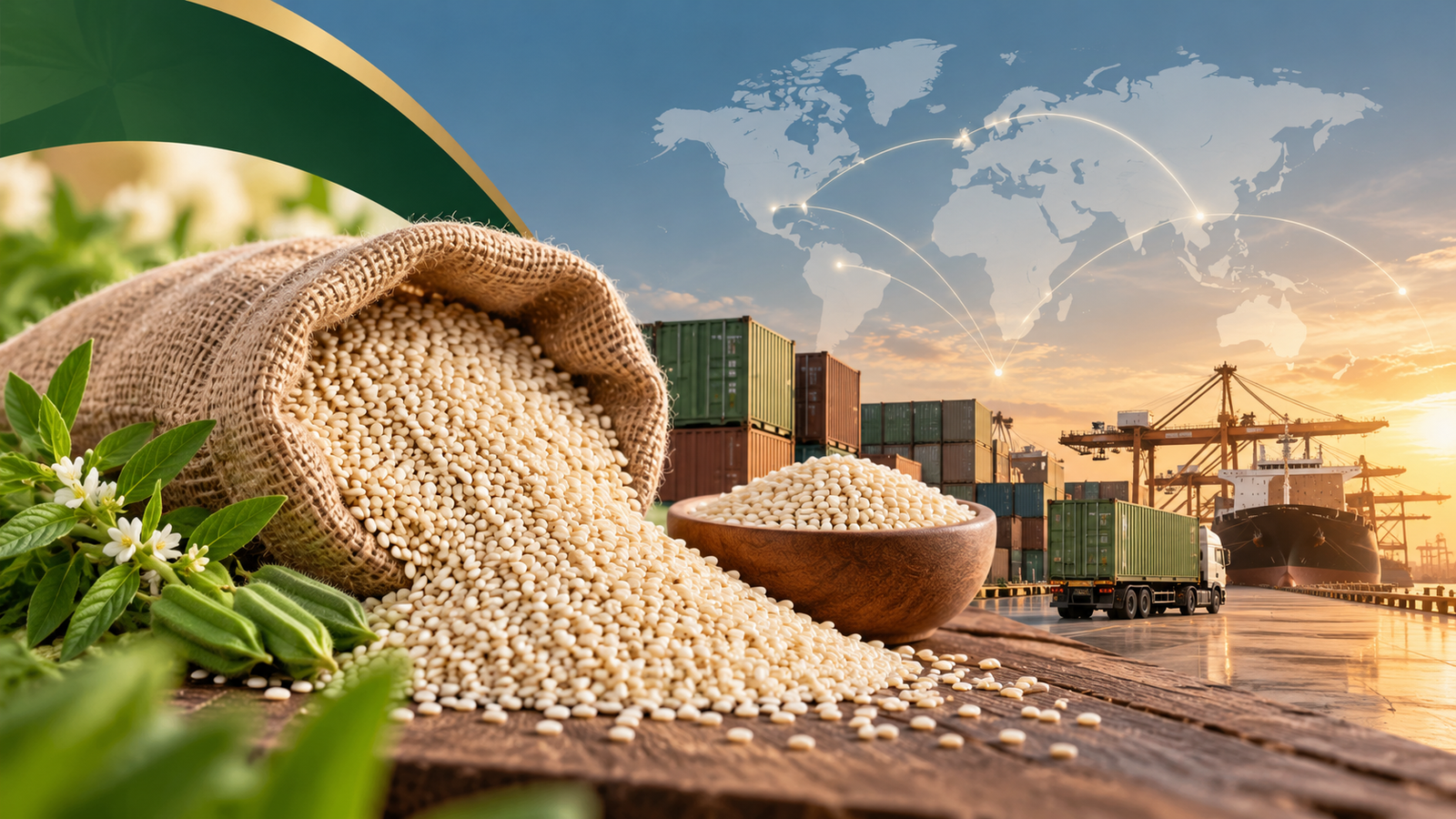
Pakistan has become an important sourcing destination for sesame seeds, attracting international buyers looking for natural, cleaned, hulled and processed sesame products. Sesame seeds are widely used in bakeries, food manufacturing, confectionery, tahini production and edible oil processing.
For international buyers, however, finding the right supplier involves more than comparing prices. Product purity, food safety, processing methods, packaging, export documentation and delivery reliability can directly affect the success of an import order.
The best sesame seeds exporters understand these requirements and help buyers source products that match their commercial and technical needs.
Pakistan has an active sesame export industry, with established exporters serving buyers across different markets. Trade-data provider Volza identifies companies such as Armcom, Hassan Ali Rice Export Company and Sakhi International among suppliers with substantial recorded sesame-related shipment activity.
This guide introduces sesame seed exporters in Pakistan, explains the products they offer and outlines the key factors buyers should evaluate before selecting a long-term supply partner.
- Leading Sesame Seeds Exporters in Pakistan
- Why International Buyers Source Sesame Seeds From Pakistan
- What Buyers Should Look for in Sesame Seeds Exporters
- Natural vs. Hulled vs. Roasted Sesame Seeds
- How to Import Sesame Seeds From Pakistan
- Common Mistakes Buyers Make When Choosing Sesame Seeds Exporters
- Why Long-Term Partnerships Matter in Sesame Seed Trading
- Why FieldFusion Corp Is a Strong Choice for Sesame Seed Exports From Pakistan
- Frequently Asked Questions
- Who are the top sesame seeds exporters in Pakistan?
- What types of sesame seeds does Pakistan export?
- What should I check before buying sesame seeds in bulk?
- Which sesame seeds are best for tahini production?
- Does FieldFusion Corp export hulled sesame seeds?
- How can I contact FieldFusion Corp for bulk sesame seed exports?
Leading Sesame Seeds Exporters in Pakistan
Pakistan’s sesame export sector includes agricultural trading companies, commodity processors and businesses focused on international food supply chains. Each company has different strengths, product offerings and export capabilities.
The following companies are relevant options for international buyers researching Pakistani sesame suppliers.
1. FieldFusion Corp – Agricultural Export Partner for Global Buyers
FieldFusion Corp is an export-focused agribusiness based in Pakistan and part of Iqbal Group of Companies. The company connects Pakistani agricultural products with international buyers through sourcing, quality management, processing and export coordination.
Sesame seeds are one of FieldFusion’s core export products, alongside rice, corn and other agricultural commodities.
FieldFusion offers several sesame seed varieties and processing options to support different food industry requirements.
FieldFusion’s Sesame Seed Portfolio
- Natural Machine-Cleaned Sesame Seeds: Suitable for buyers seeking natural sesame seeds that have undergone mechanical cleaning to remove unwanted material.
- Natural Color Sortex Sesame Seeds: Processed using optical color sorting to improve visual consistency and remove discolored seeds.
- Hulled Sesame Seeds: Sesame seeds with their outer hull removed, commonly used in tahini, bakery products and confectionery.
- Hulled Roasted Sesame Seeds: Processed sesame seeds with a roasted flavor and aroma, suitable for selected food manufacturing applications.
These product categories allow buyers to explore sesame options based on processing needs, product use and target-market requirements. FieldFusion’s published product portfolio confirms these four offerings.
Why Consider FieldFusion Corp?
FieldFusion positions its business around quality, compliance, sourcing transparency and long-term international trade relationships. Its wider agricultural portfolio can also be useful for buyers sourcing multiple commodities from Pakistan.
For importers, food processors and wholesale distributors, FieldFusion offers a commercial contact point for discussing sesame seed requirements, product specifications, packaging and export arrangements.
Buyers should request current technical specifications, available quantities, applicable certificates and shipment terms before placing an order.
2. Armcom – Established Sesame Export Market Participant
Armcom is another company worth considering when researching sesame seeds exporters in Pakistan.
Shipment-based trade records identify Armcom among the more active suppliers in relevant Pakistani sesame product categories. This makes the company a useful option for buyers who want to compare potential suppliers using historical trade activity.
Importers should confirm current product availability, processing options, quality specifications and destination-market experience directly with the company.
3. Sakhi International – Sesame Processing and Export
Sakhi International, associated with Sakhi Group, is an established name in Pakistan’s sesame export sector.
The company promotes hulled sesame seeds for food manufacturing applications such as bakery products, tahini, confectionery and edible oil production.
Its product information highlights cleaning, sorting and export-grade packaging, while trade records also show sesame-related shipment activity.
For buyers, Sakhi International may be relevant when evaluating processed sesame products and established export operations.
4. Hassan Ali Rice Export Company – Agricultural Commodity Exporter
Hassan Ali Rice Export Company is another Pakistani supplier identified in international shipment records involving sesame-related products.
Although its company name highlights rice, available trade records also show activity in sesame categories.
International buyers can include the company in their supplier research while confirming its current sesame product range, processing capabilities and export terms before proceeding.
5. HAS Trading – Natural and Hulled Sesame Seed Supplier
HAS Trading is a Pakistani agricultural commodity business that promotes natural and hulled sesame seeds for international buyers.
The company highlights its experience in agricultural commodities and offers third-party pre-shipment inspection arrangements for buyers seeking additional checks on product quality, quantity and weight.
Its sesame product offering makes it another potential supplier for businesses comparing natural and processed sesame options.
Why International Buyers Source Sesame Seeds From Pakistan
Pakistan offers international buyers access to sesame seeds for several food and industrial applications. The country has agricultural sourcing networks and export businesses that supply natural, cleaned and processed sesame products.
The commercial value of Pakistani sesame depends on several factors, including crop quality, processing methods, product specifications and the ability to meet destination-market requirements.
Different Sesame Products for Different Industries
One reason sesame remains an important traded commodity is its wide range of uses.
Natural sesame seeds are used in food production, edible oil processing and various traditional food products. Hulled sesame seeds are commonly used in tahini, bakery items, confectionery and other processed foods.
Roasted sesame seeds can also be used in ready-to-use food ingredients and products where flavor and aroma are important.
Buyers should choose sesame varieties based on their final application rather than treating all sesame seeds as the same product.
Access to Different Processing Options
Pakistani sesame exporters offer different processing grades, including machine-cleaned, color-sorted and hulled sesame seeds.
These processing methods can improve cleanliness, appearance and suitability for specific manufacturing requirements.
However, the processing method alone does not guarantee a particular purity level or food safety result. Buyers should always request the technical specification and supporting test information for the actual product being purchased.
What Buyers Should Look for in Sesame Seeds Exporters
Selecting the right sesame exporter is one of the most important decisions for international food businesses. A reliable supplier should provide consistent product quality, clear specifications, appropriate food safety controls, dependable supply and professional export support.
The following factors can help importers evaluate sesame seeds exporters in Pakistan.
1. Product Purity and Quality Standards
Purity is an important quality measure when buying sesame seeds in bulk. It refers to the proportion of sesame seeds in a shipment compared with foreign materials such as dust, stones, plant matter and other unwanted substances.
Different buyers require different purity levels based on the product’s final use.
For example, a sesame buyer purchasing seeds for oil extraction may have different quality needs from a food manufacturer producing tahini or premium bakery products.
Buyers should evaluate several product characteristics before confirming an order.
| Quality Parameter | Why It Matters |
|---|---|
| Purity | Helps determine cleanliness and the amount of foreign material |
| Moisture | Affects storage stability and the risk of mold growth |
| Oil content | Important for edible oil and tahini production |
| Color consistency | Supports visual quality in bakery and food products |
| Foreign matter | Helps assess cleaning effectiveness |
| Damaged seeds | Can affect appearance, processing and final product quality |
| Free fatty acid level | Can help assess oil quality and storage condition |
According to the Centre for the Promotion of Imports from developing countries (CBI), sesame grading depends on buyer requirements, with purity, moisture, oil content and seed quality among the main considerations.
Buyers should agree on measurable specifications and request relevant test results rather than relying on general descriptions such as premium or export quality.
2. Food Safety and International Compliance
Food safety is a major concern when importing sesame seeds, especially when the product will be used in food manufacturing.
International buyers should understand the food safety requirements of their destination market before choosing a supplier.
For example, European buyers must consider rules covering pesticide residues, contaminants and microbiological safety.
The CBI identifies Salmonella contamination, pesticide residues and traceability as important issues for sesame entering the European market.
Reliable sesame seeds exporters should be prepared to discuss testing procedures, quality records, applicable certifications and the requirements of the buyer’s destination country.
3. Processing and Cleaning Capabilities
The way sesame seeds are processed can directly affect their quality, appearance and suitability for different industries.
Common processing methods include machine cleaning, gravity separation, optical color sorting, hulling and roasting.
Machine cleaning helps remove unwanted materials, while color sorting improves the visual consistency of the seeds.
Hulling removes the outer covering of the seed, making the product suitable for applications that require a smoother texture or lighter appearance.
Roasting changes the flavor and aroma of sesame seeds, making them useful in selected food products.
When comparing sesame exporters, buyers should ask which processing methods are available and whether the final product meets their required specifications.
4. Consistent Bulk Supply
International food manufacturers and distributors often need regular shipments rather than a single order.
A sesame exporter should therefore be evaluated on its ability to supply agreed quantities while maintaining product quality.
Buyers should ask about sourcing arrangements, available stock, seasonal supply, processing capacity and lead times.
A supplier that can fulfil a trial order may not always be able to support a larger long-term contract.
This is why buyers should discuss expected annual volumes and future demand before choosing an export partner.
5. Packaging and Storage Standards
Sesame seeds require proper storage and packaging to protect their quality during transportation.
Poor storage conditions can increase the risk of moisture damage, contamination and product deterioration.
The CBI advises exporters to keep sesame in suitable storage conditions and use packaging that protects the product during international trade. Common bulk export packaging includes polypropylene and multi-layer paper bags, depending on buyer requirements.
Buyers should confirm packaging materials, bag sizes, labeling, pallet arrangements and container loading requirements before finalizing the purchase.
6. Export Documentation and Logistics
International sesame trade involves more than processing and packaging the product.
Exporters must coordinate shipping arrangements and provide the documentation required for the transaction.
Depending on the destination and commercial agreement, buyers may require commercial invoices, packing lists, certificates of origin, bills of lading and relevant inspection or food safety documents.
A reliable sesame seeds exporter should communicate these requirements early and explain which party is responsible for each part of the shipment.
Clear logistics planning helps buyers reduce the risk of avoidable delays and unexpected costs.
Natural vs. Hulled vs. Roasted Sesame Seeds
Choosing the correct sesame product is important because different processing methods support different food applications.
| Sesame Type | Main Characteristics | Common Applications |
|---|---|---|
| Natural Machine-Cleaned | Retains the outer hull and undergoes mechanical cleaning | Oil extraction, general food processing |
| Natural Color Sortex | Natural seeds sorted for improved color consistency | Bakery, food ingredients, wholesale supply |
| Hulled Sesame Seeds | Outer hull removed for a smoother texture | Tahini, confectionery, bakery |
| Hulled Roasted Sesame Seeds | Hulled seeds processed through roasting | Snacks, seasonings, ready-to-use food ingredients |
FieldFusion Corp’s sesame portfolio includes all four of these product categories, giving buyers different sourcing options based on their requirements.
How to Import Sesame Seeds From Pakistan
Importing sesame seeds from Pakistan generally involves several steps, beginning with supplier selection and ending with customs clearance and delivery.
Step 1: Define Your Product Requirements
Before contacting exporters, buyers should identify the type of sesame seeds they need, expected quantity, purity requirements, moisture limits, packaging preferences and destination market.
Clear requirements make it easier for suppliers to prepare accurate quotations.
Step 2: Shortlist Suitable Exporters
Research sesame seeds exporters with relevant product offerings and export experience.
Review their company information, processing capabilities, quality management approach and available documentation.
For larger orders, independent verification and supplier due diligence may be appropriate.
Step 3: Request Samples and Technical Specifications
Buyers should request product samples and technical specifications before committing to a major order.
Where necessary, independent laboratory testing can help confirm that the product meets agreed quality and food safety requirements.
Step 4: Confirm Commercial Terms
Once product quality is agreed, buyers should discuss pricing, minimum order quantity, packaging, payment arrangements and shipping responsibilities.
International commercial terms such as FOB, CFR and CIF should be clearly understood by both parties before signing the agreement.
Step 5: Arrange Shipment and Documentation
The exporter and buyer should coordinate shipment planning, required documents and any inspections needed for the destination market.
Both parties should also agree on how shipment updates and delivery information will be communicated.
Step 6: Verify the Shipment Upon Arrival
After the shipment reaches its destination, the buyer should follow the agreed inspection and receiving process.
Any differences in quantity, packaging or product quality should be handled according to the purchase agreement.
Common Mistakes Buyers Make When Choosing Sesame Seeds Exporters
International buyers can face avoidable problems when supplier selection is based only on price or broad marketing claims.
One common mistake is failing to define product specifications clearly. Two exporters may quote different prices because they are offering different grades, processing methods or quality levels.
Another mistake is assuming that all sesame seeds meet the same food safety requirements. Import rules can vary between countries, and compliance should be checked for the actual destination market.
Buyers should also avoid relying entirely on product samples without agreeing on shipment-level quality requirements.
Poor communication about packaging, payment terms, shipment schedules and documentation can create problems even when the product itself meets the agreed standard.
A strong procurement process should address these issues before the order is confirmed.
Why Long-Term Partnerships Matter in Sesame Seed Trading
For importers, wholesalers and food manufacturers, choosing a sesame supplier is not always a one-time decision.
Regular supply relationships can help businesses maintain product consistency, plan procurement and manage changing demand.
Long-term partnerships also allow buyers and exporters to develop a better understanding of each other’s requirements.
Over time, this can improve communication, quality planning, shipment coordination and the handling of future orders.
The right sesame seeds exporter should therefore be evaluated not only on the first quotation but also on its ability to support the buyer’s wider business needs.
Why FieldFusion Corp Is a Strong Choice for Sesame Seed Exports From Pakistan
Finding the right sesame seeds exporter requires a balance of product quality, processing options, sourcing capability and dependable export support.
FieldFusion Corp, part of Iqbal Group of Companies, brings these priorities together through its agricultural export business.
With sesame seeds among its core products, FieldFusion serves international buyers seeking natural machine-cleaned, color-sorted, hulled and hulled roasted sesame seeds from Pakistan.
Its broader business approach focuses on sourcing, quality control, processing, compliance and export coordination, with the aim of building reliable relationships across international markets.
FieldFusion also exports rice, corn and other agricultural commodities, making it a potential sourcing partner for buyers with wider agricultural procurement needs.
For importers, distributors and food manufacturers looking for a long-term agricultural export partner, FieldFusion offers a direct opportunity to discuss product requirements, available specifications and commercial supply arrangements.
Looking to import sesame seeds from Pakistan? Explore FieldFusion’s sesame seed product portfolio or contact FieldFusion Corp to discuss your bulk sourcing requirements.
Frequently Asked Questions
Who are the top sesame seeds exporters in Pakistan?
Pakistani sesame exporters include FieldFusion Corp, Armcom, Sakhi International, Hassan Ali Rice Export Company and HAS Trading. Buyers should compare their product offerings, quality standards, shipment experience and current supply capabilities rather than relying on a single ranking.
What types of sesame seeds does Pakistan export?
Pakistan exports natural sesame seeds, machine-cleaned sesame seeds, color-sorted sesame seeds, hulled sesame seeds and other processed sesame products. Available grades and processing methods vary by exporter.
What should I check before buying sesame seeds in bulk?
Buyers should check product purity, moisture, oil content, processing method, food safety requirements, packaging, supplier capacity and export documentation. Testing and independent inspection may also be appropriate for larger orders.
Which sesame seeds are best for tahini production?
Hulled sesame seeds are commonly used for tahini because removing the outer hull helps create a smoother texture and lighter appearance. Buyers should also assess flavor, oil content, food safety and processing requirements.
Does FieldFusion Corp export hulled sesame seeds?
Yes. FieldFusion Corp lists hulled sesame seeds and hulled roasted sesame seeds in its export product portfolio, alongside natural machine-cleaned and color-sorted sesame products.
How can I contact FieldFusion Corp for bulk sesame seed exports?
International buyers can visit FieldFusion Corp’s official website to review its products and contact the company about specifications, quantities, packaging, pricing and export arrangements.
Comments are closed